

In 1892 The State Normal and Industrial School opened with a Department of Ancient and Modern Languages, including a Department of Latin which offered a four year curriculum, and Departments of French and German which offered a three year curriculum. A minimum of three years of Latin was required for all students. (1892-94 Courses of Study). Due to increasing numbers of students, in 1893 Viola Boddie, Head of the Departments of Latin and French in 1882-83, began to teach only Latin. She continued as the Department Head of Latin until 1934-35 when she taught part-time before retiring the next year. Viola Boddie wrote the Department of Latin Report for 1898, which is signed by her and her Assistant in Latin, Mary Sanders. It is located in the UNCG Archives.
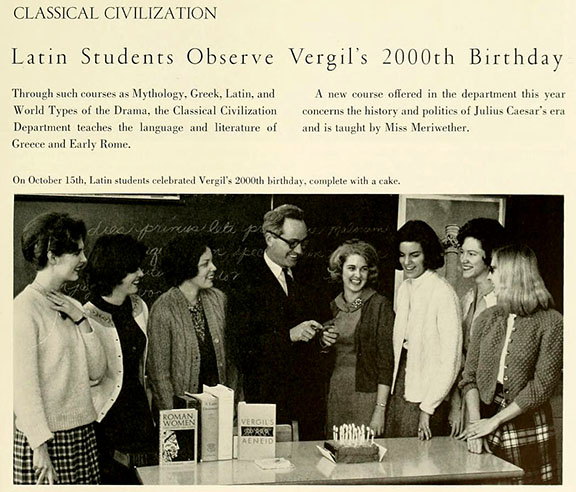
In 1935, The Department was renamed the Department of Classical Civilization and offered ancient Greek for the first time (4 courses), in addition to its 20 Latin courses, and 2 courses in English on Greek and Roman literature. Students could now major in Latin Language and Literature or Greek Language and Literature. The Department continued to thrive and to add new courses, as a notice of a birthday party for Vergil’s 2000th birthday (Pine Needles yearbook 1964) attests.
In 1974, Archaeology became part of the curriculum for the first time, with a 200-level course “Introduction to Classical Archaeology” offered in the fall by Pamela Benbow (Asst. Professor 1974-1976). The Department began offering separate B.A. degrees in Latin and in Greek.
A Civilization concentration is added to the existing language concentrations for each degree in 1978. The department began several years of administration under acting Heads from other departments, with an external advisory committee also serving from 1983-1987. J. Douglas Minyard serves as Department Head for the next two years, 1987-88 and 1988-89. In 1986, The Department is renamed the Department of Classical Studies—which it will be known as for the next 37 years.
In 1989, The Department undertook a whole-scale restructuring of its programs and curriculum in order to attract more students, to make the major programs more possible for students to complete, to increase its commitment to teacher education, and to include as many general education (AULER) courses as possible in its offerings. At the same time the Department began to explore the needs of Latin teachers in North Carolina and won a grant to offer the first Governor’s Institute in Latin at the graduate level. Professor Susan C. Shelmerdine began service as Department Head, and served until 1992 when Jeffrey Soles assumed the Headship. The first Governor’s Institute in Latin was offered at UNCG in the summer of 1990 and planning began in the same year for the creation of a graduate degree program for Latin teachers.
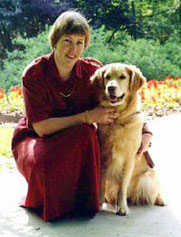
As a result of its restructuring process in 1991, the Department discontinued its two existing B.A. programs and began offering a single B.A. degree in Classical Studies with four concentrations (Classical Archaeology, Classical Civilization, Greek Language and Literature, Latin Language and Literature) and a special “A” certification track for prospective teacher education students. The new M.Ed. program in Latin, created in response to continuing demand by in-service Latin teachers in the state, begins enrolling students in 1993. The M.Ed. program in Latin later underwent revisions to meet new state standards effective in 2000. Susan C. Shelmerdine replaces Jeffrey Soles as Department Head in 1999, reassuming her position from years prior.
The Department revised and expanded its curriculum in 2006, and restructured the B.A. degree in Classical Studies to have three concentrations (Classical Archaeology, Classical Civilization, Language and Literature) and a certification track for teacher education students. At the end of May, the Department, along with other humanities departments housed in the McIver Building, moved to the new Moore Humanities and Research Administration Building at the corner of Spring Garden and Forest Streets, where the department remains to this day.
UNCG in Rome, a new 4 week study abroad course was added to the curriculum in 2010, to be offered every other summer. It joined the Mochlos Project in Greece as the Department’s second regular opportunity for students to travel and study abroad. Later, in 2012, A summer Field School with the Kea Archaeological Research Survey (KARS) in Greece became the third study/travel abroad option offered by department faculty, run by Dr. Joanne Murphy–the current Department Head.
In 2023, following the UNCG Academic Portfolio Review, the Classical Studies Department merged with the Archaeology Department to create the Department of Ancient Mediterranean Studies and Archaeology. The combined major now offers an entirely online Bachelors of the Arts in Ancient Mediterranean Civilization, and as well has more classes pertaining to archaeology. As of 2025, AMSA at UNCG is the largest undergraduate classical studies program in North Carolina.
This entry was made possible by Professor Emerita Dr. Susan Shelmerdine’s timeline of AMSA history.
Department Heads:
Viola Boddie (1892 – 1934)
Marie B. Denneen – Acting Head (1934 – 1935)
Charlton C. Jennigan (1935 – 1949)
Francis A. Laine (1949 – 1978)
*Interdepartmental Committee on Classical Civilization (1983 – 1987)
J. Douglas Minyard (1987 – 1989)
Susan C. Shelmerdine – Acting Head (1989 – 1992)
Jeffrey Soles (1992 – 1999)
Susan C. Shermerdine (1999 – 2009)
Hugh Paker (2009 – 2017)
Maura Heyn (2017 – 2023)
Joanne Murphy (2023 – Present)
*During these years there was not a head of the classical studies department. There were heads from different departments acting simultaneously as the head, while having an external advisory committee.
Department Names:
Department of Ancient and Modern Languages (1892)
Department of Latin (1915)
Department of Classical Civilization (1935)
Department of Classical Studies (1986)
Department of Ancient Mediterranean Studies and Archaeology (2023)